
Choosing the right CRM, marketing automation, and client management platform isn’t just about features — it’s about value, flexibility, agency support, pricing transparency, and scalability for your business model.
In the HubSpot vs HighLevel (often called GoHighLevel) debate, both platforms are highly capable. But when you compare them holistically — especially for agencies, service businesses, and small‑to‑mid sized teams — HighLevel comes out on top. Here’s why.
1. What These Platforms Are Really Made For
HubSpot is a powerful enterprise‑grade CRM suite known for its all‑in‑one marketing, sales, and service hubs. It’s widely adopted by scaling businesses and enterprises for deep inbound marketing and advanced analytics.
HighLevel was built from the ground up for agencies, consultants, and service providers — designed to replace a whole stack of tools (funnels, email/SMS marketing, CRM, calendar, automation) under one roof with predictable pricing.
2. Pricing: Predictable vs Paywalls
One of the biggest differentiators between these two platforms is how much you really pay:
HubSpot Pricing
- Offers a free CRM tier.
- Additional marketing, sales, and service tools are sold as separate “Hubs” with tiered pricing.
- Advanced features often require Professional/Enterprise plans — and can become costly quickly. Kixie
✔ Benefit: Great flexibility
🚫 Drawback: Can be expensive and hard to predict
HighLevel Pricing
- Subscription includes most functionality in one tier.
- No per‑user pricing or crazy upcharges.
- Unlimited users and clients, especially valuable for agencies.
✔ Benefit: Simple, predictable pricing
✔ Benefit: Great value for small businesses and agencies
🚫 Drawback: Not as modular as HubSpot
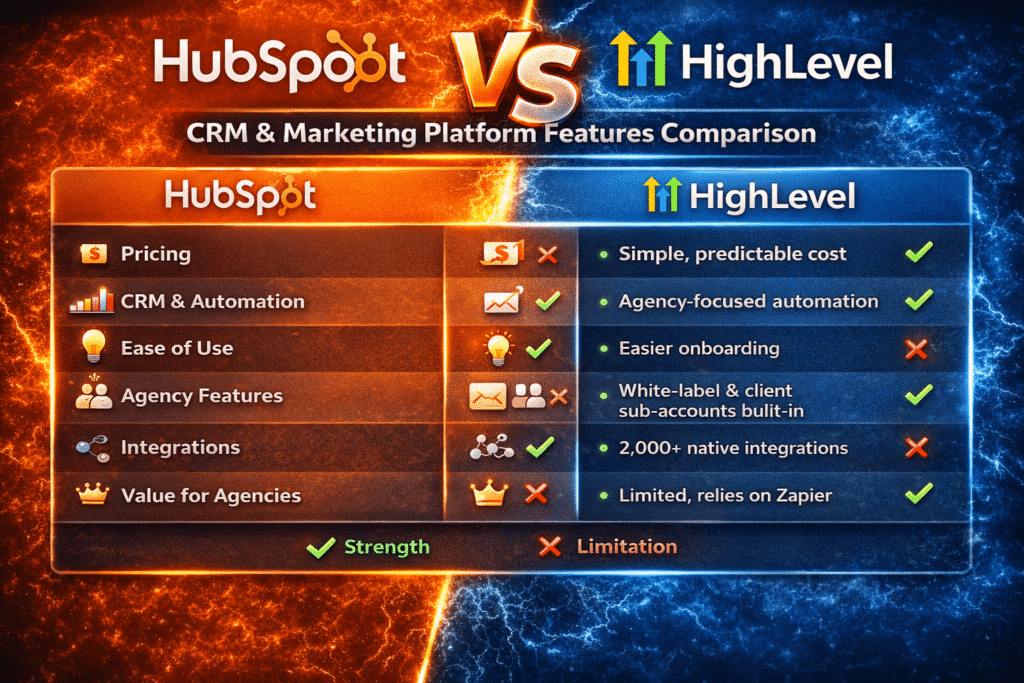
WINNER: HighLevel — especially for agencies and teams who want full functionality without tier‑confusion or add‑ons.
3. Features & Automation: More Than Just CRM
Both platforms offer CRM and automation mechanisms — but the focus and execution differ:
HubSpot Strengths
- Deep analytics and data segmentation
- Excellent inbound marketing tools
- Highly polished user experience and knowledge base
- Huge ecosystem of third‑party integrations
HighLevel Strengths
- Built‑in funnels, workflows, calendars, email/SMS sequences
- Dedicated tools for agencies (sub‑accounts, white‑label branding)
- Higher scores in social marketing and campaign automation according to G2 reviewers, especially for media campaigns and cross‑system integration. G2+1
HighLevel’s automation focuses on closing the gap between tools and execution rather than just analyzing and reportinglike HubSpot.
WINNER: HighLevel — for integrated automation that replaces multiple tools.
4. Ease of Use: Onboarding vs Capability
- HubSpot has a reputation for a clean, intuitive UI, excellent documentation, and a lower learning curve — especially for teams new to CRM software. Appvizer
- HighLevel has more features bundled into one platform, which can feel overwhelming at first — but that complexity gives much more power and flexibility once learned.
HubSpot may be easier to start with, but HighLevel gives more tools without needing 10+ separate SaaS subscriptions.
WINNER: Tie — HubSpot for ease; HighLevel for depth.
5. Agency & White‑Label Capabilities
If you’re an agency, this is where HighLevel decisively wins:
- White labeling and client sub‑accounts built in
- CRM dashboards you can brand and resell
- Funnels, reporting, calendars, and automation for multiple clients
HubSpot doesn’t offer native white‑labeling and is usually licensed per user or per tool.
WINNER: HighLevel — essential for agency operations and scaling.
6. Integration Ecosystem
HubSpot impresses here.
- Thousands of native integrations
- Seamless connections with tools like Salesforce, Slack, Shopify, Zoom, payment systems, and more
HighLevel’s integrations are strong but more limited natively — requiring Zapier or similar if a direct integration doesn’t exist.
WINNER: HubSpot — if your business relies on a large tech stack.
7. Customer Support & Community Feedback
G2 comparison data shows:
- HubSpot often scores higher in customer support quality.
- HighLevel scores very highly in features like drag‑and‑drop tools and campaign management, particularly for small business use.
Support matters — but where HighLevel sometimes trails, robust documentation and active communities often fill the gap for users willing to learn.
8. The Practical Choice: Who Should Use Which?
Choose HubSpot If:
✔ You’re a mid‑sized business or enterprise
✔ You need deep reporting & analytics
✔ Your tech stack is complex and integration intensive
Choose HighLevel (Our Winner) If:
✔ You run an agency or client services business
✔ You want an all‑in‑one platform that replaces multiple tools
✔ You care about predictable pricing and value
✔ You want funnels, automation, calendars, CRM, and messaging in one place
Final Verdict: GoHighLevel Wins
HubSpot is powerful and polished, especially for inbound marketing and large teams. But for agencies, entrepreneurs, and service businesses who want the most value per dollar, bundled automation tools, and agency‑focused features, HighLevel wins hands down.
Why? Because it’s built to run your entire client lifecycle — not just manage data. Its inclusive pricing, automation depth, and agency‑ready features make it the smarter choice for most modern small business stacks.